








It is a crucial step to select the best possible hosting provider for your website, application, online store, games, or any business venture that you might have. A small website can do well with shared hosting, but the same might not work with the growth of your project, and VPS could offer a better optio n; at some point, you might require something more.
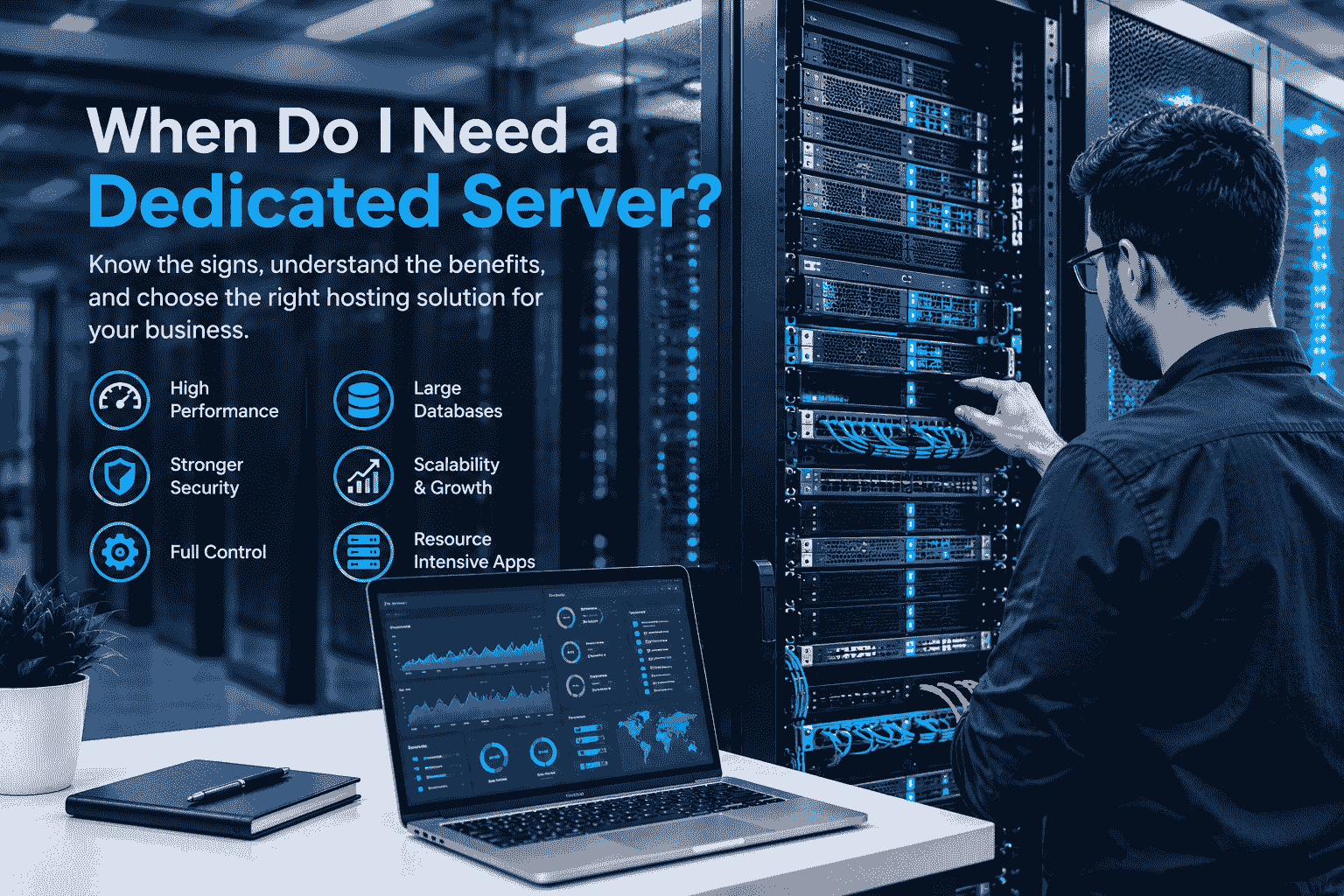
So, when do I need a dedicated server?
It would be best to go for a dedicated server in cases where you need your website or application to perform optimally, have many resources, complex configurations, enhanced isolation, or more control over the server environment. Unlike shared servers, where your account runs on a physical server alongside accounts from other users, a dedicated server will provide you with an entire machine to work on.
The following guide outlines situations that would require a dedicated server, signals that it is time to upgrade, and considerations to make prior to the decision.
What Is a Dedicated Server?
What is a Dedicated Server?
A dedicated server is a piece of hardware that is reserved for one particular client only. While with shared hosting services, there are many websites sharing one and the same server resources, a dedicated server offers exclusive access to hardware components such as CPU, RAM, hard drives, etc.
The client has more freedom regarding the ways of configuring the server. It all depends on the provider and the server itself whether one can choose the processor, memory, type of hard drive, operating system, and other aspects.
Dedicated servers are usually used by organizations or websites with heavy traffic.
When Do I Need a Dedicated Server?
There is no particular traffic number that necessarily dictates that you require a dedicated server. It all depends on your workload, software, traffic, resources, security requirements, etc.
Here are a few cases where a dedicated server would come in handy.
1. Your Website Has High Traffic
The most frequent reason for companies to migrate to dedicated hosting services is the rising volume of website traffic.
When your website attracts thousands or even millions of users, it requires considerable CPU, memory, database, storage, and bandwidth capacity. If your current hosting solution cannot cope with this volume, users will face slow loading speeds, mistakes, and even downtime.
Dedicated hosting allows your website to have full access to the resources of a particular hardware device instead of having to share it with other websites.
But the volume of traffic shouldn’t be the only criterion for your choice. Sometimes, an optimally configured website with moderate traffic can require fewer resources than a poorly optimized application with significantly smaller numbers of users.
Here, you need to check the performance of the server in terms of CPU usage, memory usage, I/O of the hard drive, database, and network traffic.
2. Your Website Is Consistently Using Too Many Resources
Another sign that you may need a dedicated server is consistently high resource usage.
For example, you may notice:
- CPU usage regularly reaching high levels
- RAM frequently becoming exhausted
- Slow database queries
- High disk usage
- Increasing server response times
- Frequent resource-limit notifications
- Websites becoming slow during peak hours
- Applications experiencing performance problems
If these problems continue after optimization, caching, database improvements, and other technical fixes, upgrading your hosting environment may become necessary.
A dedicated server provides significantly more predictable access to physical resources.
3. You Run a Large E-Commerce Website
E-commerce website servers may require a more stringent setup when compared to informational websites.
An online shop will require features such as search capabilities for products, account creation, shopping carts, payment options, inventories, databases, ordering systems, and high levels of traffic from promotions.
This is especially the case during promotional periods or holiday seasons.
A dedicated server will offer the necessary computing capacity for performing e-commerce-related tasks. It will also offer control to technical experts on server settings, caching, databases, security systems, and optimization.
Server performance will become critical to customer experience for a well-established online shop.

4. You Need More Control Over the Server
Limited control is generally the case with shared servers since the server has been built in such a way as to accommodate many users.
Dedicated servers will give you more control over your server’s operating system, server applications, security settings, databases, applications, etc.
It can be very helpful for developers or system administrators who require special configurations on their servers.
For example, you may need to:
- Install specific software
- Configure custom firewall rules
- Modify server-level settings
- Run specialized applications
- Configure custom databases
- Use specific operating systems
- Set up advanced monitoring
- Configure custom networking
- Run multiple services
If your project requires this level of control, a dedicated server can provide a suitable environment.
5. Your Application Requires High CPU Performance
Some applications require significantly more processing power than a typical website.
Examples include:
- Data processing applications
- Video processing
- Large databases
- Business applications
- Scientific workloads
- Complex analytics systems
- Rendering applications
- Large-scale automation systems
In cases where there is a heavy processing burden on the program, a server with a good CPU will definitely be able to handle the required processing capabilities.
It is necessary to look at the actual demands on the CPU before opting for the hardware. Having multiple CPU cores does not necessarily resolve all performance issues.
6. You Need Large Amounts of RAM
Some applications are intensive in their use of memory.
Big databases, caches, virtualization, analytics solutions, and business applications may need a lot of RAM.
If the server lacks sufficient memory, the OS will make heavy use of disk-based virtual memory, resulting in poor performance.
With a dedicated server, you will be able to pick a hardware setup with much more memory if it is needed.
For instance, a business application may start off with a small amount of RAM but will need more as the database and user base increase.
7. You Need Specialized Hardware
Another reason to consider dedicated hosting is the need for specific physical hardware.
Some applications may benefit from:
- High-core-count CPUs
- Large amounts of RAM
- Enterprise SSD storage
- NVMe storage
- Hardware RAID
- Specialized networking
- GPU acceleration
A VPS may provide flexible virtual resources, but certain workloads can benefit from direct access to dedicated physical hardware.
If your application has specialized hardware requirements, discuss the exact specifications with your hosting provider before selecting a server.
8. You Run a Large Database
The database could become the biggest performance bottleneck as the site grows larger.
It could be that the database is in need of considerable memory, quick storage, good CPU performance, and proper database configuration.
A dedicated server can be set up with fast SSD/NVMe storage and lots of memory, which would help with better consistent performance of heavy databases.
But merely shifting the under-optimized database to a dedicated server will not be enough; other factors such as database indexing and queries, among others, have to be looked at.
9. Your Business Requires Predictable Performance
Sometimes, shared hosting can face problems of resource contention due to the fact that different websites share the same physical resources.
When using a dedicated server, you separate your usage from other customers sharing the same physical server.
Predictability of performance might be important for business applications.
For example, a company may need a stable environment for:
- Customer portals
- Internal applications
- E-commerce systems
- Business databases
- APIs
- Enterprise software
Predictable resources can make capacity planning and performance monitoring easier.
Dedicated Server vs VPS
A common question is whether you need a dedicated server or whether a VPS is sufficient.
A VPS provides a virtualized server environment on a physical machine. It generally offers more control and dedicated resource allocations than basic shared hosting.
A dedicated server gives you the entire physical machine.
Here is a basic comparison:
| Feature | VPS | Dedicated Server |
| Physical hardware | Shared | Entire server |
| Resource isolation | Virtualized | Physical |
| Performance | Good to high | High |
| Customization | High | Very high |
| Scalability | Often easy | Hardware-based |
| Cost | Usually lower | Usually higher |
| Management | Provider-dependent | Provider-dependent |
| Best for | Growing projects | Resource-intensive workloads |
A VPS may be sufficient for many growing websites. You should consider a dedicated server when your workload consistently exceeds what your VPS can efficiently provide or when your project requires dedicated physical resources.
10. You Need Stronger Server Isolation
Security and isolation can also influence the decision.
A dedicated server is a server where your applications run on hardware that belongs to your firm alone. Such an approach would alleviate worries about sharing the physical machine with other unrelated users.
Sensitive applications run by firms would opt for dedicated hardware to ensure more control over the environment of the server.
However, dedicated hardware does not automatically make a server secure.
You still need:
- Strong passwords
- Firewall configuration
- Regular software updates
- Malware monitoring
- Secure SSH access
- Backup systems
- Access controls
- Security monitoring
- Proper application security
Server security is a combination of infrastructure, configuration, software, and operational practices.
11. You Need to Host Multiple Websites
It may happen that agencies, companies, and developers have to control many websites through one server.
The dedicated server offers sufficient resources for hosting many websites and applications but still provides an opportunity for the administrator to set up the system according to certain needs.
For instance, an IT agency may consider hosting its clients’ websites through the dedicated server provided it offers sufficient CPU, RAM, storage, and bandwidth resources.
Nevertheless, it is necessary to plan resources well because just hosting many websites through one server will not mean good performance for sure.
12. You Need a Dedicated Environment for Applications
Not every server workload is a traditional website.
Organizations may need to host:
- APIs
- SaaS applications
- Customer management systems
- ERP software
- CRM platforms
- Development environments
- Internal business applications
- Collaboration software
These applications may require customized server environments and predictable resources.
A dedicated server can give developers and administrators greater flexibility when deploying these systems.

13. You Experience Frequent Performance Problems
Performance problems can be a strong signal that your current hosting solution needs to be evaluated.
You may notice:
- Slow page loading
- High server response time
- Application timeouts
- Database errors
- Slow backend dashboards
- Unexpected downtime
- Poor performance during traffic spikes
Before moving to a dedicated server, investigate the underlying cause.
Performance issues can result from:
- Poorly optimized code
- Large images
- Slow database queries
- Missing caching
- Incorrect server configuration
- Plugin conflicts
- Insufficient resources
- Network problems
If optimization does not resolve the issue and resource limitations are confirmed, dedicated hosting may be a logical next step.
14. You Expect Rapid Business Growth
When your business is expanding rapidly, planning your hosting infrastructure ahead of time could prove helpful.
For instance, your website might be performing well on a VPS now, but it will require a lot more bandwidth once you have launched your marketing campaign.
This way, you can assess whether your current infrastructure will be able to manage the incoming load.
A dedicated server will give you more resources, but just because you foresee expansion does not mean that you should buy it at all costs.
Sometimes, cloud infrastructure or scalable VPS would be more suitable for unpredictable loads.
15. You Need High Storage Performance
Storage can have a major impact on server performance.
Traditional hard disk drives may be sufficient for certain workloads, but demanding applications can benefit from SSD or NVMe storage.
Dedicated servers can often be configured with large and fast storage systems.
This can be useful for:
- Large databases
- File storage
- Media platforms
- Backup systems
- High-traffic websites
- Application servers
- Data-intensive workloads
When selecting storage, consider both capacity and performance.
16. You Need Better Resource Planning
The benefit associated with using specialized hardware includes effective resource planning.
The available amount of physical CPU, RAM, storage, and networking resources is known, allowing for better monitoring and planning of upgrades.
For instance, if your computer regularly uses 80-90% of available RAM, it is possible to predict that memory might become a problem in the future.
Monitoring tools can help you track:
- CPU utilization
- RAM usage
- Disk space
- Disk I/O
- Network bandwidth
- Database performance
- Application response time
This information is much more useful than making an upgrade decision based only on website traffic.
When You May Not Need a Dedicated Server
A dedicated server is not necessary for every website.
You may not need one if you have:
- A small personal website
- A basic blog
- A low-traffic business website
- A simple portfolio
- A new website
- A small development project
For these types of websites, shared hosting, managed WordPress hosting, or a VPS may provide enough resources at a lower cost.
Starting with a smaller hosting plan can also make financial sense because you can upgrade when your actual resource requirements increase.
How Much Traffic Requires a Dedicated Server?
There is no universal traffic threshold.
For example, one website with 100,000 monthly visitors might use fewer resources than another website with 20,000 visitors.
Why?
Because resource consumption depends on factors such as:
- Page size
- Caching
- Database queries
- Dynamic functionality
- Plugins
- Images and videos
- Application architecture
- Visitor behavior
- API requests
Instead of focusing only on visitors, examine actual server resource usage.
This provides a more accurate answer to the question: when do I need a dedicated server?
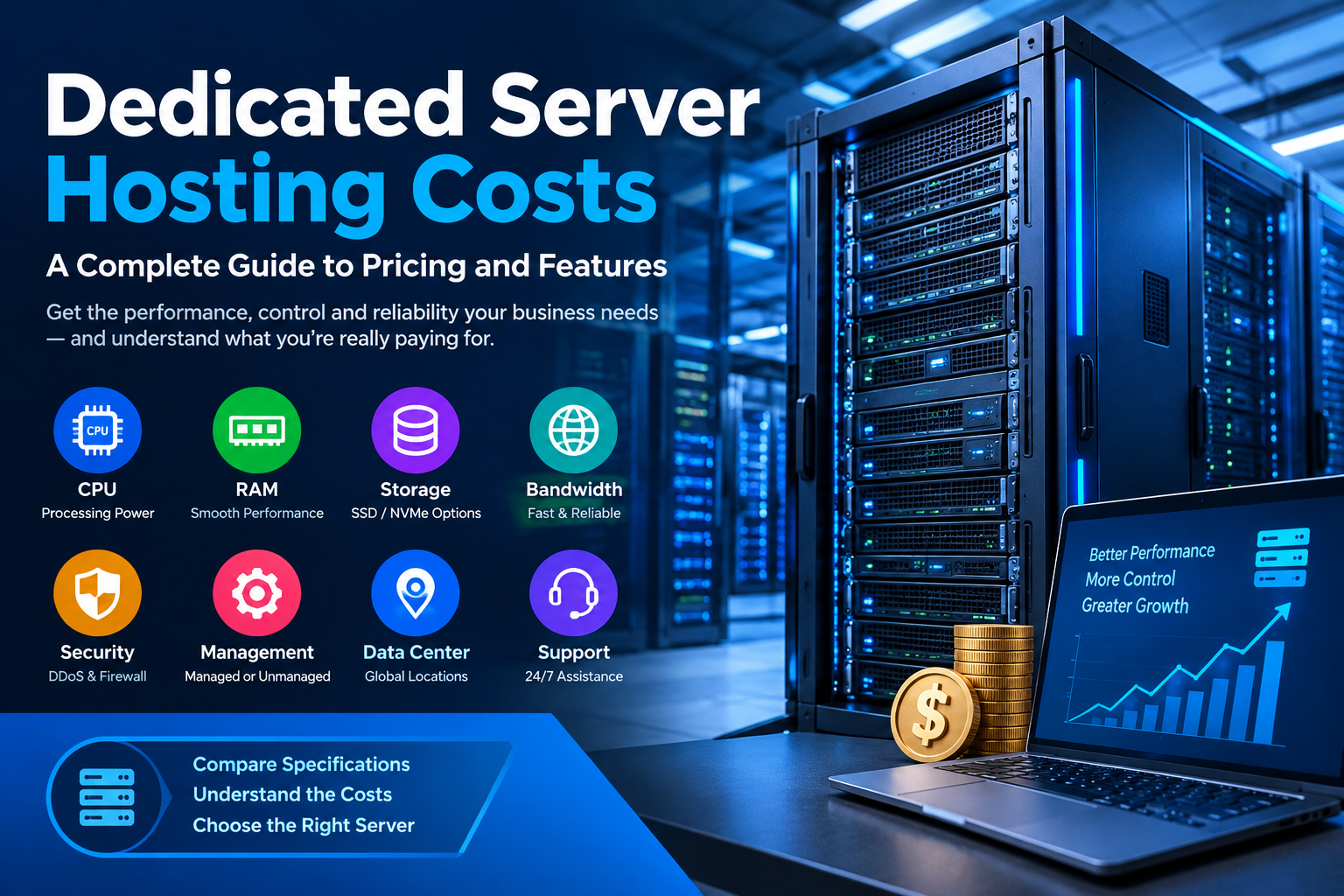
Dedicated Server Costs
Dedicated servers generally cost more than shared hosting and many VPS plans because you are paying for an entire physical machine and its infrastructure.
The total cost may include:
- Server hardware
- CPU
- RAM
- Storage
- Bandwidth
- Operating system
- Server management
- Backup services
- Security services
- Control panel licenses
- Additional IP addresses
When comparing providers, do not look only at the monthly price.
Consider the complete package, including hardware specifications, network quality, support, backup options, management, data center location, and service-level commitments.
Managed vs Unmanaged Dedicated Servers
Dedicated servers can generally be offered as managed or unmanaged services.
Managed Dedicated Server
With managed hosting, the provider handles many server administration tasks.
This can include:
- Operating system updates
- Security updates
- Server monitoring
- Basic troubleshooting
- Configuration assistance
- Backup management
Managed hosting can be useful if you want to focus on your business rather than server administration.
Unmanaged Dedicated Server
With an unmanaged server, you have more responsibility for administration.
You may need to handle:
- Server setup
- Security
- Updates
- Firewall configuration
- Software installation
- Monitoring
- Troubleshooting
- Backups
Unmanaged hosting can provide more control, but it generally requires stronger technical knowledge.
How to Decide If You Need a Dedicated Server
Before upgrading, ask yourself the following questions:
- Is my current server consistently reaching resource limits?
- Is my website experiencing performance problems?
- Do I need more CPU or RAM?
- Do I need high-performance storage?
- Do I need custom server-level configurations?
- Does my application require specialized hardware?
- Do I need stronger physical resource isolation?
- Is my database becoming too large for the current environment?
- Do I manage multiple resource-intensive websites?
- Can my current hosting plan handle future growth?
If several of these questions apply to your project, it may be time to evaluate dedicated hosting.
How to Prepare Before Moving to a Dedicated Server
Moving to a dedicated server should be planned carefully.
First, analyze your current hosting environment.
Check CPU, RAM, storage, bandwidth, database performance, and traffic patterns.
Next, determine your hardware requirements.
For example, decide whether you need:
- More CPU cores
- More RAM
- SSD or NVMe storage
- Additional storage capacity
- Higher network bandwidth
- Specific operating systems
- Specialized hardware
You should also plan your migration process.
A typical migration may involve:
- Ordering the new server
- Installing the operating system
- Configuring security
- Migrating website files
- Migrating databases
- Testing applications
- Configuring DNS
- Testing the live environment
- Monitoring performance
- Keeping the old server available temporarily
A careful migration can reduce downtime and unexpected problems.

Benefits of Using a Dedicated Server
A dedicated server can provide several important benefits.
Dedicated Resources
CPU, RAM, storage, and other hardware resources are allocated to your environment.
Better Performance
Resource-intensive applications can benefit from powerful dedicated hardware.
Greater Control
Administrators can customize the operating system and server configuration.
Improved Isolation
Your workloads run on physical hardware assigned to your organization.
Flexible Configuration
You can select hardware specifications according to your workload.
Suitable for Large Applications
Dedicated infrastructure can support demanding websites, databases, applications, and other workloads.
Potential Disadvantages
Dedicated servers also have disadvantages.
The biggest consideration is cost. A dedicated server typically costs more than basic hosting solutions.
Administration can also require technical knowledge, especially with unmanaged servers.
You may also need to handle:
- Security
- Updates
- Monitoring
- Backups
- Server configuration
- Troubleshooting
For this reason, a dedicated server is not automatically the best solution for every project.
Frequently Asked Questions
When do I need a dedicated server?
You may need a dedicated server when your website or application consistently requires more CPU, RAM, storage, performance, control, or isolation than your current hosting environment can provide.
Is a dedicated server better than a VPS?
A dedicated server will offer you a full physical server, whereas a VPS offers you a virtual server environment. Your selection will depend on the nature of your work.
Does high traffic always require a dedicated server?
Not necessarily. Just having high traffic does not always dictate whether you require dedicated hosting because there are many other factors to consider.
Is a dedicated server good for e-commerce?
It can be suitable for large e-commerce websites that require substantial resources, predictable performance, and greater server control.
Is dedicated hosting expensive?
Dedicated hosting generally costs more than shared hosting and many VPS solutions because you are using an entire physical server.
Can I host multiple websites on a dedicated server?
Yes. A dedicated server can host multiple websites, depending on the available hardware resources and server configuration.
Do I need technical knowledge to use a dedicated server?
It depends on whether the server is managed or unmanaged. Managed dedicated hosting can reduce the amount of server administration you need to perform.
Can I upgrade a dedicated server?
Hardware upgrades depend on the hosting provider and server configuration. Some providers allow RAM, storage, or other hardware upgrades, while others may require moving to a different server.
Final Thoughts
So, when do I need a dedicated server?
It really depends on your current workload, not just one particular figure for traffic.
A dedicated server may become necessary if you need high performance from your website/application constantly, a lot of CPU and RAM, fast disks, complex configuration, special hardware, or more physical isolation of the resources.
But first, check your current server performance. Pay attention to the CPU load, RAM load, disk I/O, database, bandwidth, response times, and other features and needs of your application.
If you are running into limitations of your current hosting constantly and optimization does not help anymore, then maybe it is time to think about moving to a dedicated server.
Or, maybe, you have just a small website or a newly created project that doesn’t require any serious resources, in which case shared hosting or a VPS is enough.
So, the best choice for hosting will depend on your application’s needs, current resource usage, expectations for development, knowledge and skills, and budget, but not just on the number of website visitors.



One thought on “When Do I Need a Dedicated Server? A Complete Guide”