






If you are managing a website, hosting account, domain, email service, or server, you may have heard about cdpanel. The term is commonly used when people search for cPanel, a popular web hosting control panel that makes website and hosting management easier. Instead of performing many server-related tasks through complicated command-line tools, users can manage important hosting functions through a graphical interface.
No matter whether you are a novice, website owner, blogger, developer, freelancer, or an SEO professional, knowledge about cdpanel will help you make website management very easy. Using cPanel, you can easily manage website files, domains, email accounts, databases, backups, security, and other hosting options.
cPanel is evolving with each modern version of cPanel. The existing cPanel dashboard comes with several tools that cover websites, emails, files, databases, security, and performance. Some of the features are either enabled or disabled depending on the hosting service you are using.
In this guide, we will explain what cdpanel is, how it works, its most important features, how beginners can use it, and why it remains useful for website management.
What Is cdpanel?
cdpanel is a commonly searched spelling of cPanel, a web-based hosting control panel designed to simplify website and hosting management.
The official interface of cPanel enables management of domains, web content, emails, SQL databases, files, and many more web services.
Generally, the management of a web server entails technical skills,s as one may have to give commands through the command line, work with configuration files, FTP programs, databases, or even server administration interfaces. The control panel takes care of most of these hassles using the graphical user interface.
For instance, rather than configuring an email account manually on the server, you would be able to go to the Email Accounts tab and create the account using the graphical user interface.
In a similar way, instead of using FTP to transfer a file for your website, you could simply use the File Manager feature in cPanel.
This makes cPanel especially useful for people who want easier control over their hosting account.
How DoescPanel Work?
The basic idea behind cPanel is simple.
Your hosting provider will have a web server. It is where your website files, databases, emails, and other hosting services are hosted. cPanel acts as an interface between you and the various hosting services.
Once you sign in to your hosting account, you will be able to access different tools according to the access privileges given by your hosting provider.
For example, you may see tools for:
- Domains
- File Manager
- Email Accounts
- Databases
- Backups
- SSL
- Security
- FTP
- DNS
- Website applications
- Performance monitoring
The exact interface can vary depending on your cPanel version and hosting provider.
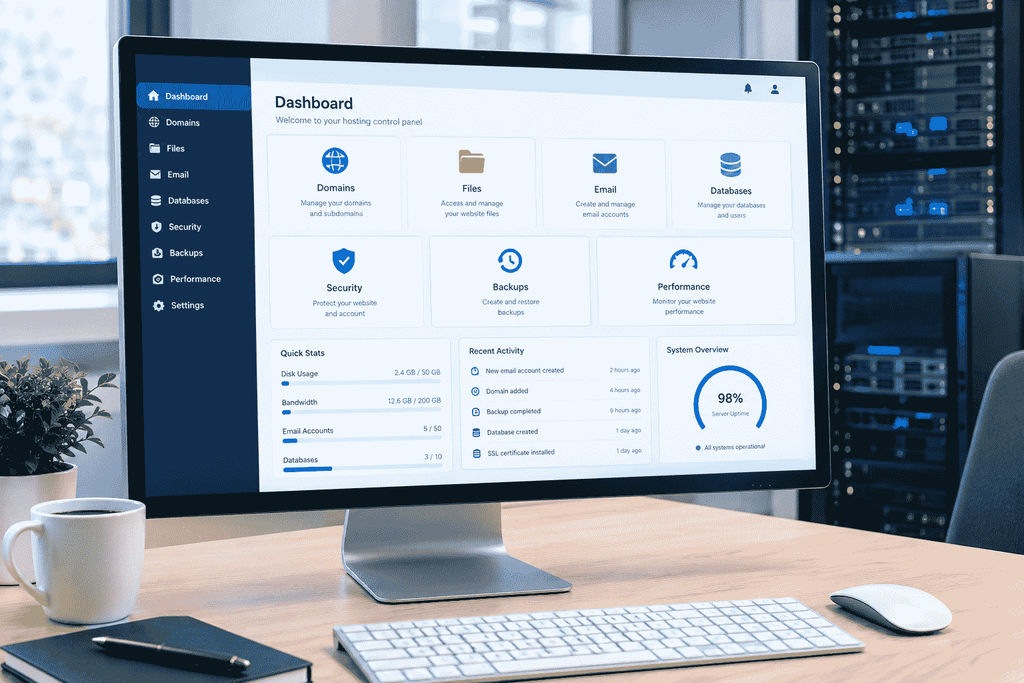
The latest cPanel interface, for example, organizes tools into goal-based hubs such as Websites, Email, Files, Databases, Security, and Performance.
Why Is cPanel Important for Website Owners?
Website owners need to perform many tasks after purchasing hosting. You may need to upload files, create an email address, install WordPress, create databases, manage domains, configure SSL, or restore a backup.
Without a control panel, some of these tasks can be difficult for beginners.
cdpanel makes these tasks more accessible through a visual interface.
For example, a small business owner can use the hosting panel to create a professional email such as:
info@example.com
The blogger is able to manage the files and databases on their website.
The SEO specialist is able to view the directories, redirects, SSL settings, and many other technical aspects.
The developer can handle the database, FTP account, PHP settings, and app files.
It is this flexibility that makes hosting companies still use cPanel hosting services.
Main Features of cdpanel
There are many tools available inside cPanel. However, beginners should focus on the most important features first.
1. File Manager
File Manager is one of the most useful tools in cPanel
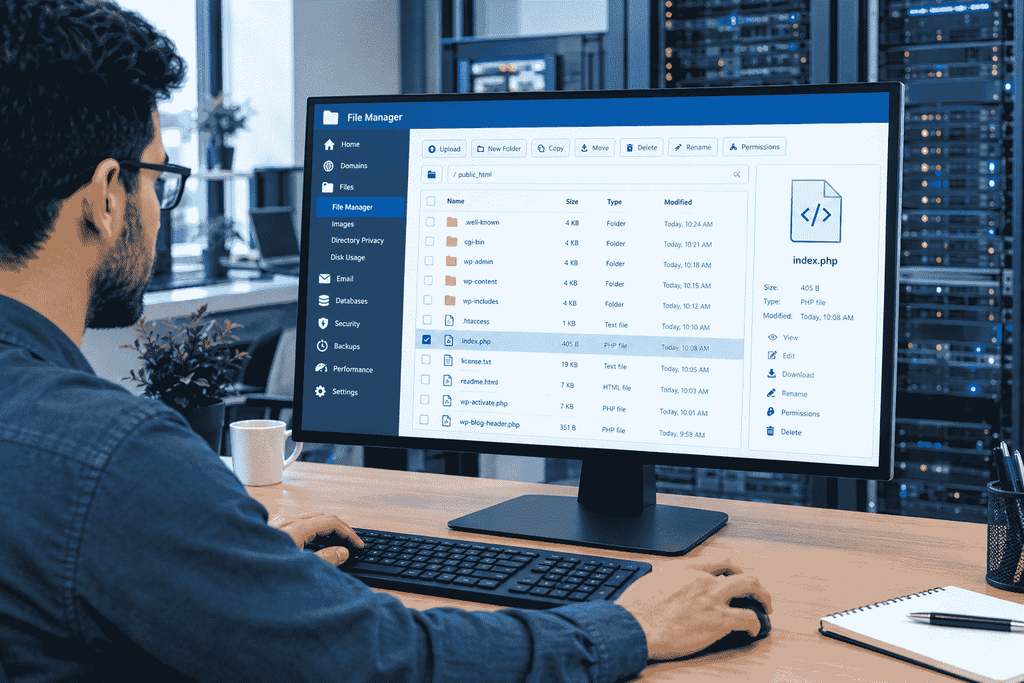
It allows you to access and manage files stored in your hosting account. You can upload, download, edit, rename, move, copy, and delete files and folders.
For many websites, the main public website files are located inside a web root such as public_html, although the exact document root depends on the domain configuration.
You may use File Manager to:
- Upload HTML files
- Upload images
- Edit configuration files
- Manage WordPress files
- Create folders
- Rename files
- Delete unnecessary files
- Upload plugins or themes manually
- Check website directories
Official documentation confirms that cPanel File Manager can be used to manage and edit account files.
Important: Beginners should avoid deleting files unless they know what those files do. A small mistake in a configuration file can sometimes make a website stop working.
2. Domain Management
Another important part of cdpanel is domain management.
Based on the chosen hosting package, it might be possible for you to configure and administer a number of domains through one cPanel account.
The Domains feature allows you to manage domains, document roots, HTTPS redirects, and other settings.
For example, you might have:
- example.com
- example.net
- blog.example.com
Each website or domain can have its own configuration and document root.
However, remember that cPanel does not replace your domain registrar. Domain registration and renewal are normally handled through your registrar.
3. Email Accounts
Professional websites often need custom email addresses.
With cPanel, hosting providers may allow you to create email accounts associated with your domain.
For example:
- info@example.com
- support@example.com
- sales@example.com
- contact@example.com
You can usually create, manage, and delete email accounts through the Email Accounts section.
This is particularly useful for businesses because a domain-based email address generally looks more professional than using a generic free email address.
4. Databases
Many modern websites require databases.
WordPress, e-commerce websites, forums, membership systems, and other web applications often depend on databases to store information.
Depending on your hosting environment, cdpanel can provide tools for creating and managing databases and database users.
Common database-related tools include:
- MySQL databases
- MariaDB databases
- Database Wizard
- phpMyAdmin
- Database users
You should be careful when modifying databases manually. Always create a backup before making major database changes.
5. SSL and HTTPS
Website security is another important area.
An SSL certificate enables encrypted HTTPS connections between visitors and your website. Modern websites should use HTTPS rather than unsecured HTTP.
Depending on your hosting provider, cdpanel may provide SSL-related tools that help manage certificates and HTTPS settings.
A secure website usually uses an address beginning with:
https://
HTTPS is important for protecting data and building user trust.
It is also an important technical consideration for modern websites and SEO.
6. Backup Management
Backups are essential for every website.
A website can experience problems because of:
- Plugin conflicts
- Theme errors
- Malware
- Accidental file deletion
- Database problems
- Server issues
- Incorrect configuration
- Failed updates
Backups provide you with a means to retrieve website data when necessary.
The cPanel Backup feature enables users to download their website backups. Users will be able to restore some website data depending on the hosting service. In other cases, they would need to contact the hosting provider in order to restore certain data.
Taking backups before making big changes to your website is a good idea.
For instance, before making changes to the WordPress configuration file, you have to take a backup.
7. FTP Accounts
FTP stands for File Transfer Protocol.
It allows files to be transferred between a computer and a hosting server.
Although File Manager is convenient, developers and website managers sometimes prefer FTP or SFTP-based tools for uploading and managing larger numbers of files.
The cdpanel environment may allow you to create and manage FTP accounts depending on your hosting configuration.
FTP can be useful when:
- Uploading many files
- Moving website files
- Working with development projects
- Connecting external FTP software
- Managing specific website directories
For security, use secure file-transfer methods whenever your hosting environment supports them.
8. DNS Management
The domain name system relates domain names with services and servers.
When an individual inputs a domain name in his/her browser, DNS will assist in finding where the domain name needs to point.
cPanel Zone Editor is a tool which enables management of DNS entries provided by your host.
Common DNS records include:
- A record
- AAAA record
- CNAME record
- MX record
- TXT record
- NS record
DNS changes should be made carefully. Incorrect DNS records can cause websites or email services to stop working.
If you are not sure what a DNS record does, it is better to check with your hosting provider before changing it.
9. Security Features
Website security should never be ignored.
Modern cPanel environments can include several security-related tools depending on the hosting provider.
These may include:
- SSL management
- IP blocking
- Directory privacy
- Hotlink protection
- ModSecurity
- Password and security settings
- Two-step verification
- HTTPS configuration
The exact security features available depend on the hosting provider and server configuration.
For beginners, the most important security habits are simple:
- Use a strong password.
- Enable two-factor authentication when available.
- Keep WordPress updated.
- Keep plugins and themes updated.
- Remove unused software.
- Maintain regular backups.
- Avoid sharing hosting credentials.
- Use HTTPS.
10. Performance Monitoring
It is essential for the performance of websites both for users and search engines.
Based on your cPanel version and hosting setup, you might have access to information about website performance such as bandwidth, number of visits, errors, and resource usage.
In the new Meridian cPanel interface, there is a Performance tab with information like bandwidth, number of visits, errors, and overall website statistics.
This information will help you determine any hosting issues.
For instance, if your website starts using way more resources than usual, it means you have to look into possible traffic peaks, plugins, or scripts used by your site.
How to Log In to cdpanel
The exact login address depends on your hosting provider.
Official cPanel documentation explains that users can access cPanel through a domain or server IP using port 2083 when that access method is enabled.
A hosting provider may also give you a direct login button inside its customer dashboard.
A typical process is:
Step 1: Open Your Hosting Account
Log in to your hosting provider’s customer dashboard.
Step 2: Find the cPanel Option
Look for an option such as:
- cPanel
- Manage Hosting
- Control Panel
- Hosting Control Panel
Step 3: Open cPanel
Click the relevant button.
Some hosting companies automatically log you into cPanel without requiring a second username and password.
Step 4: Review the Dashboard
Once inside, review the available tools and account information.
Do not change settings unless you understand what they do.
How to Upload a Website Using cdpanel
If you have a simple HTML website, you can upload your files through File Manager.
The basic process is:
- Log in to cdpanel.
- Open File Manager.
- Open the appropriate website document root.
- Locate public_html if it is the document root for your main domain.
- Upload your website files.
- Make sure your homepage file is correctly named.
- Visit your domain in a browser.
- Check whether the website loads correctly.
However, there is another procedure for WordPress since WordPress needs PHP files, a database, and configuration.
Many web hosts have an easy WordPress installer or manager that is quite convenient for newbies. The cPanel documentation states that “WordPress Management / WP Toolkit” is one of such tools.
cdpanel and WordPress
WordPress is one of the most common applications used with cPanel hosting.
A typical WordPress hosting setup may include:
- Domain
- Hosting account
- WordPress files
- Database
- SSL certificate
- Email accounts
- Backups
You can often use cdpanel to manage the underlying hosting environment while using WordPress to manage your website content.
For example, WordPress controls:
- Posts
- Pages
- Themes
- Plugins
- Menus
- Media
- SEO settings
While cPanel can help manage:
- Files
- Databases
- Domains
- Backups
- SSL
- Hosting-level settings
This combination is useful because WordPress handles content management while cPanel handles many hosting-related tasks.
cPanel for SEO Professionals
If you work in SEO, understanding cdpanel can be valuable.
SEO is not only about keywords and content. Technical website health also matters.
A hosting control panel can help you access technical areas such as:
- Website files
- Redirect configuration
- SSL
- DNS
- Error logs
- Backups
- Database management
- Domain configuration
For instance, when a client complains about their website being down suddenly, it is important to first check the server side before checking the page.
Likewise, during the migration of websites, File Manager, databases, domains, DNS, SSL, and backups might be of significant importance.
Nevertheless, it is not advisable for SEO experts to alter any server settings without considering the effect they might have.
Common Mistakes Beginners Make in cPanel
Mistake 1: Deleting Unknown Files
Never delete a file simply because its name looks unfamiliar.
Some files are required by WordPress, PHP applications, plugins, themes, or server configurations.
Mistake 2: Editing Configuration Files Without a Backup
Configuration files can affect the entire website.
Create a backup before changing important files.
Mistake 3: Changing DNS Records Randomly
DNS changes can affect website traffic, email delivery, verification systems, and other services.
Mistake 4: Ignoring Security
Never share your cPanel login credentials with people you do not trust.
Mistake 5: Not Maintaining Backups
A backup can save you significant time when something goes wrong.
Mistake 6: Using Weak Passwords
Your hosting account controls important website resources. Use a strong, unique password and enable additional security features when available.
Is cdpanel Easy for Beginners?
Yes. cdpanel is designed to simplify many hosting tasks.
You do not need to become a professional server administrator to perform basic tasks such as:
- Creating email accounts
- Uploading files
- Managing domains
- Checking disk usage
- Creating backups
- Managing databases
- Checking SSL
- Managing FTP accounts
However, advanced server administration is different.
If you start working with:
- Server configuration
- PHP versions
- DNS architecture
- Security rules
- Database optimization
- Cron jobs
- Advanced caching
- Apache configuration
- Server-level permissions
you should understand what you are changing before applying it.
cdpanel vs Traditional Server Management
Traditional server management can require command-line knowledge and direct configuration.
For example, an administrator might need to use SSH commands to create directories, edit configuration files, manage services, inspect logs, and perform other operations.
cdpanel provides graphical tools for many common tasks.
This does not mean cPanel eliminates the need for technical knowledge. Instead, it reduces the complexity of routine hosting management.
Best Practices for Using cdpanel
If you manage websites regularly, follow these best practices.
Keep Regular Backups
Do not rely on a single backup. If possible, maintain backups in a separate location.
Use Strong Authentication
Use strong passwords and two-factor authentication when your hosting provider supports it.
Keep Your Software Updated
Update WordPress, plugins, themes, PHP versions, and other applications according to compatibility and security requirements.
Monitor Disk Space
Large backups, images, logs, emails, and unused files can consume hosting storage.
Remove Unused Files
Unused applications and old files can create security and maintenance problems.
Check SSL Regularly
Make sure your website is using HTTPS and that certificates remain valid.
Be Careful With DNS
Always verify DNS records before making changes.
Do Not Change Server Settings Without Understanding Them
If you are unsure about an advanced setting, contact your hosting provider or a qualified administrator.
What Can You Do With cPanel
There are many things you can do with cdpanel.
Here is a quick overview:
| Task | Can cPanel Help? |
| Manage website files | Yes |
| Create email accounts | Yes |
| Manage domains | Yes |
| Create databases | Yes |
| Manage FTP accounts | Yes |
| Manage backups | Yes |
| Manage SSL | Yes, depending on hosting |
| Manage DNS | Yes, depending on permissions |
| Monitor resources | Yes, depending on version |
| Manage WordPress | Often available |
| Manage security tools | Yes, depending on hosting |
| Install applications | Often available |
The exact tools available depend on your hosting provider, account type, server configuration, and enabled features. cPanel specifically notes that hosting providers can enable or disable certain features.
Frequently Asked Questions About cdpanel
What is cdpanel?
cdpanel is a commonly used misspelling for cPanel, a web hosting control panel used to manage websites, domains, files, email accounts, databases, backups, security, and other hosting services.
Is cdpanel the same as cPanel?
In most hosting-related searches, people who type cdpanel are referring to cPanel. The official product name is cPanel.
Can I manage WordPress with cdpanel?
Yes. cPanel hosting can provide WordPress-related management tools, depending on your hosting provider. You can also use File Manager and database tools to manage the underlying WordPress installation.
Can cdpanel manage domains?
Yes. The Domains interface can allow users to create and manage domains, document roots, and certain domain settings, depending on account permissions.
Can I create a business email with cdpanel?
Yes. Hosting accounts that provide cPanel Email Accounts can allow you to create domain-based email addresses.
Can I back up my website with cdpanel?
Yes. cPanel provides backup tools that can be used to download and store website or account data, depending on the hosting configuration.
Is cdpanel free?
cPanel is commercial hosting software. Website owners usually access it as part of a hosting package rather than purchasing and installing it separately for a typical shared hosting setup. Pricing and availability depend on the hosting provider and plan.
Is cdpanel good for beginners?
Yes. Its graphical interface makes many common hosting tasks easier than managing everything through command-line tools.
Does every hosting account have cdpanel?
No. Some hosting companies use cPanel, while others use different control panels or custom dashboards.
Can cdpanel improve SEO directly?
cPanel is not an SEO tool in the traditional sense. However, it can help you manage technical aspects of a website that can affect SEO, including files, SSL, domains, redirects, DNS, performance information, and server-related settings.
Final Thoughts
cdpanel can be a useful tool for anyone who manages a website or hosting account. Although the correct product name is cPanel, the term cdpanel is often used in searches by people looking for a simple hosting control panel.
In case of hosting needs, cPanel allows performing all the necessary actions from file management to domain management, as well as creating email accounts, databases, backups, setting up SSL and configuring security settings.
For a beginner, it is recommended to start learning cPanel by understanding basic settings. These include File Manager, Domains, Email Accounts, Backups, SSL, L and security settings basics. Once these are mastered, one can move on to more complex settings like database management, DNS, FTP, performance monitoring, ng and other server management settings.
The most important tip is always to perform a backup before making any changes to ensure website recovery.
Overall, if the hosting service you chose supports cPanel, mastering its use may bring a lot of benefits to website management.
One thought on “cdpanel: Complete Guide to Hosting, Website and Server Management”